 Cory Zaner
How I Passed the CISSP in Two Months: The Plan, the Tools, and the Sayings That Stuck
How I passed the CISSP after about two months of study: my timeline, the tools I used, what the CAT exam felt like, and what happens after you pass.
On this page
The algorithm decides your fate#
When I posted “Passed my CISSP today” on LinkedIn, I described it as walking into an exam where an algorithm decides your fate. That still feels like the most honest way to say it. The CISSP is an adaptive test. It can end early because it’s confident you passed, end early because it’s confident you didn’t, or keep going and give you no hint which way it’s leaning. You sit there answering one hard question after another and you truly don’t know.
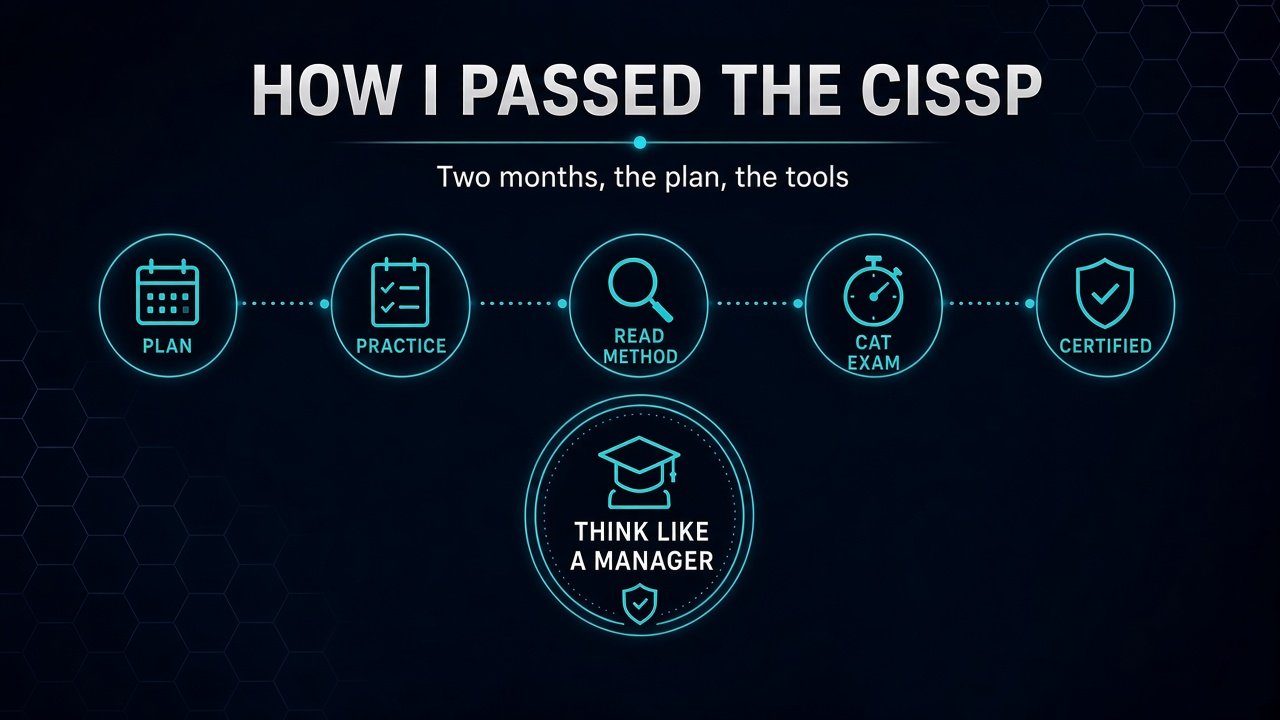
I passed on my first attempt on April 17, 2026, after about two months of study. I’m writing this because a lot of people reached out after that post, many of them studying right now, and I’d rather share what actually worked than a polished highlight reel. This is the plan, the tools, the mindset, and the paperwork nobody warns you about.
A bit of context: I’ve spent more than 24 years in cybersecurity, from the Air Force to Raytheon to enterprise security and architecture leadership in the energy sector, and I already held my CISM. Experience helped. It also got in the way, because the CISSP doesn’t want the answer a hands-on engineer would give. More on that below.
The timeline#
- Mid-February 2026: Started studying in earnest, about 15 to 20 hours a week.
- March 16: Bought the exam.
- March 29 to April 12: Heavy practice-question phase in Pocket Prep.
- April 5: Bought Quantum Exams for $199.99, about 12 days before the exam.
- April 12 to 17: My five-day final blitz, built around my own cliff notes.
- April 17: Sat the exam and passed. ISC2’s “Next Steps” email came that evening. A pass at that point is provisional until endorsement and review are done.
- April 17 (same day): Started on the endorsement paperwork.
- April 21: ISC2 confirmed it had received my endorsement documentation.
- May 8: “Congratulations, You’re CISSP Certified!” About three weeks from endorsement to certification.
My study stack, and what each piece actually did#
Pocket Prep: reps and finding weak spots. Pocket Prep was my daily driver for practice questions. From March 29 to April 12 I did 48 quizzes and 484 questions, about five and a half hours of practice, mostly in its “Level Up” mode. Short sessions on my phone added up. Its real value was showing me which domains I kept getting wrong so I could go back to them.
Quantum Exams: getting used to how the real questions read. I bought Quantum Exams on April 5 for $199.99. Pocket Prep checked what I knew. Quantum Exams trained me for the way CISSP questions are written: long scenarios, several answers that could all work, and you have to choose the best one. It also has a CAT-style simulation, which helped me get comfortable with not knowing how I was doing.
The READ strategy video: a method for every question. One of the most useful hours I spent was a YouTube session by Pete Zerger on the Inside Cloud and Security channel: “CISSP EXAM PREP: Ultimate Guide to Answering Difficult Questions” (https://youtu.be/D89-7rTFgw4). He teaches a four-step method called READ: Review what is actually being asked, Eliminate answers that are clearly wrong, Analyze the requirements in priority order, and Decide on the best remaining answer. His decision rules match how the exam thinks: human safety first, answer from the role the question gives you, prefer answers that cover the others, and be wary of hands-on technical fixes and “solve everything” answers. Having one repeatable method kept me calm on questions where two answers looked right.
My own cliff notes: the piece I’d recommend most. In the last week I built my own “CISSP Cliff Notes, 5-Day Exam Blitz” with help from an AI assistant. It took several tries. The first version was a dark-themed HTML page to read at bedtime. The second was a two-page landscape Word document, and the type was too small to read. The final version was two portrait pages in 10-point type with half-inch margins. Page one covered all eight domains with key tips and one saying per domain. Page two held the terms I kept confusing, plus mnemonics. Later I added an attack-types section that pairs each attack with a memory hook and its main defense.
Making the notes taught me more than reading them. Every time I cut the sheet down, I had to decide what really mattered. Short sayings stayed with me far better than rereading did. A few I still remember: “Risk is never eliminated, only managed.” “Classify it, own it, protect it, destroy it.” “RTO is how fast, RPO is how far back.”
One caution: check your homemade notes against isc2.org. Mine had old domain weights and the wrong question count. The current numbers are below.
The mindset: think like a manager#
If I had to fit the whole exam into one line, it would be the one at the top of my cliff notes: think like a manager, not a technician.
- Go in this order: Policy, then People, then Process, then Technology. Fix governance and people before you reach for a tool.
- Look for the most correct answer, not just one that would technically work. Usually several would work.
- Human safety comes first, every time.
- When a question asks what to do first, the answer is usually to assess the risk before adding controls.
- Prefer the answer that covers the broadest problem.
After two decades of fixing things hands-on, this was the hardest habit for me to unlearn.
Exam day and the CAT format#
My routine was simple. I went to the gym, ate a protein-heavy meal, and studied nothing new. My last hour of review covered only the few ideas that still confused me, such as which attacks map to “alteration” in the DAD model and the difference between dual control and split knowledge.
Here is how the format works, straight from ISC2:
- The CISSP uses Computerized Adaptive Testing (CAT), with 100 to 150 questions and a 3-hour limit. Any breaks count against the clock.
- Everyone answers at least 100 questions. Twenty-five of them are unscored test questions, and you can’t tell which ones.
- From question 100 on, the exam can end as soon as the algorithm is 95% confident you’re above or below the passing standard. If it never gets there, it keeps going, up to 150 questions or until time runs out.
- You can’t go back. Once you confirm an answer, you can’t review or change it. Make your best call and move on, and don’t burn ten minutes on one question.
- Every question is supposed to feel hard. The exam is designed so you get about half right, so a tough question tells you nothing about how you’re doing. Running past 100 isn’t a failing sign, and an “easy” question isn’t a bad one.
Mine ended with a comfortable amount of time left. The hardest part wasn’t any single question. It was the not knowing, right up until the screen changed.
What I’d do differently#
- Build the cliff notes earlier. They were the best study tool I had, and I made them in the last five days. I’d start a rough version in week one and trim it every week.
- Start realistic, scenario-style questions sooner. I bought Quantum Exams 12 days before the exam. I’d use it earlier, alongside Pocket Prep.
- Line up endorsement before exam day. Collect your employment proof and decide who your endorser will be ahead of time.
After you pass: requirements and the process (per isc2.org, November 2026)#
Passing is not the finish line. Here is the current process:
- Experience: You need five years of cumulative, paid, full-time work in at least two of the eight domains. Part-time work and internships can count. A relevant degree or a credential on ISC2’s approved list (for example, CISM or Security+) can waive one year. Only one year can be waived in total.
- No experience yet? You can still pass and become an Associate of ISC2. You then have six years to earn the five years of experience.
- Endorsement: You have nine months from your exam date to finish the endorsement application. An ISC2-certified member in good standing vouches for your experience. If you don’t know one, ISC2 can act as your endorser if you provide proof of employment. Some applications are randomly audited. I didn’t have a CISSP contact, so I went the ISC2 route with proof of employment.
- AMF: Once you’re approved, you pay the Annual Maintenance Fee, currently $135 a year for CISSP. Paying it completes your certification.
- CPEs: You need 120 CPE credits every three years, about 40 a year, and at least 90 of them must be Group A.
- Domain weights (current outline): D1 Security and Risk Management 16%, D2 Asset Security 10%, D3 Security Architecture and Engineering 13%, D4 Communication and Network Security 13%, D5 Identity and Access Management 13%, D6 Security Assessment and Testing 12%, D7 Security Operations 13%, D8 Software Development Security 10%. ISC2 will switch to a new exam outline on April 15, 2027. If you’re testing after that date, study from the new one.
Thank you#
Nobody passes this exam alone.
- Pete Zerger and Inside Cloud and Security, for the READ strategy and for free content that has helped thousands of candidates.
- The Pocket Prep and Quantum Exams teams, for practice tools that gave me reps and showed me how the real questions read.
- The LinkedIn community. Nearly a thousand of you reacted and more than a hundred commented on my pass post. Many of you are on your own CISSP journey right now. That encouragement meant more than you know.
If you’re studying right now#
Make your own short notes and keep cutting them down. Get lots of practice questions in, and use realistic ones too. Pick one method for working through questions and use it every time. Answer as a manager would. Then trust your preparation, and don’t read anything into how hard the questions feel. You’ve got this.